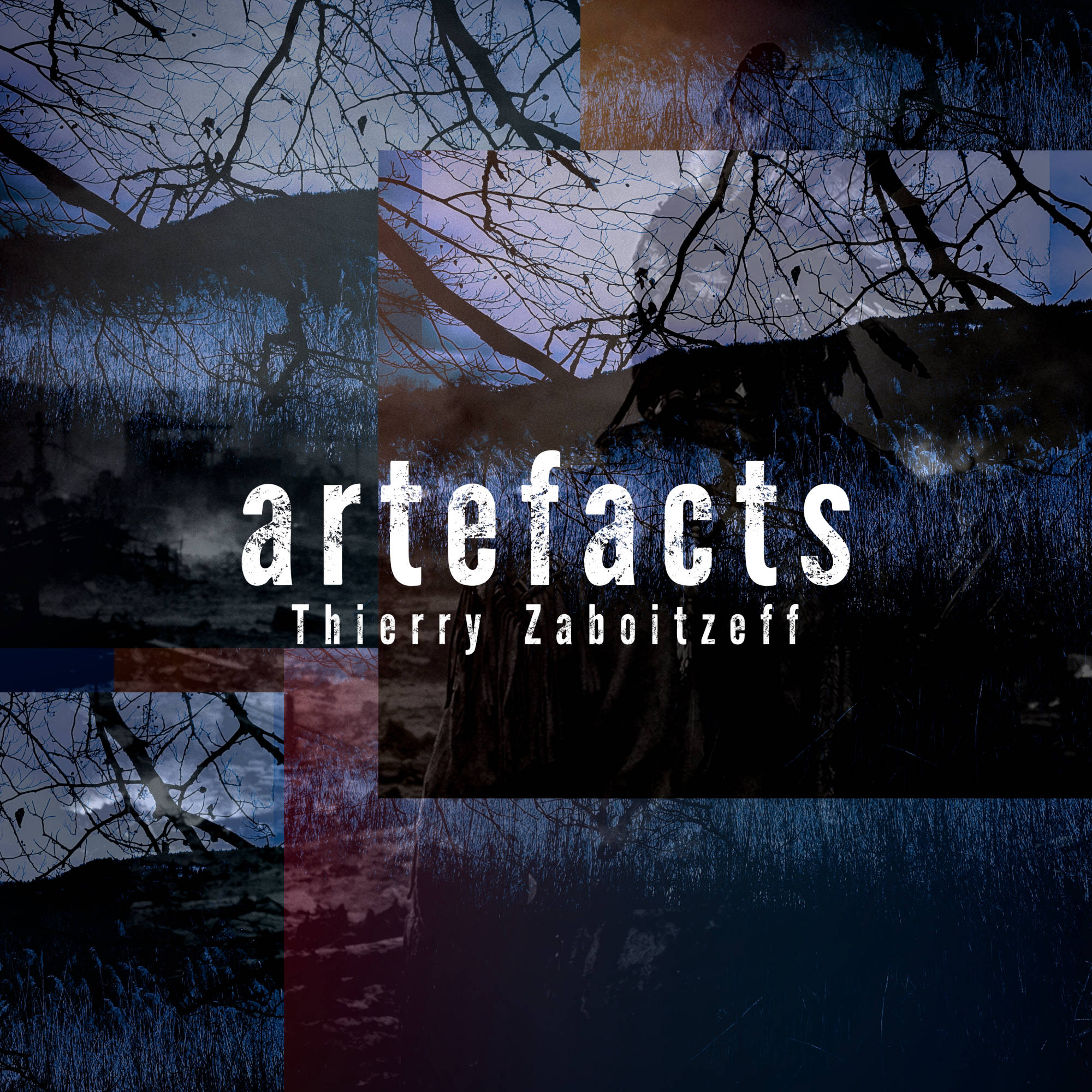
Digital album - Studio
Artist : Thierry Zaboitzeff
Label : IMD-ZABMUSIC
Digital release date: 27/02/2026
Physical release date:
Digital distribution: iMusician Digital AG
Physical distribution:
Genre: symphonic electro rock - ambient - contemporary classical - alternative - post rock - music for image.
Number of tracks :5| Duration: 28'35"
Musicians:
Thierry Zaboitzeff (interpretation - recording - mixing - electric bass - electric cello - voice - keyboards - guitar - programming of percussions and other virtual acoustic instruments)
Composition:Thierry Zaboitzeff
Artwork: Les Designers Anonymes
Liner notes : T.zaboitzeff/D.Desassis
Label: iMD-ZABMUSIC ℗ 2025 Thierry Zaboitzeff
UPC/EAN 4069493648553
Artefacts are the whispers of time solidified.
Objects created by human hands, they carry the memory of forgotten gestures, beliefs and knowledge. They are evidence, traces, sometimes mistakes, fragments of vanished cultures or mirrors of our present practices. Technical flaws, sacred relics or simple worn tools: each one tells a story, that of man seeking to understand, create, survive and leave a fragile mark on the world.
Today, after all these years, I still stand behind a microphone with the same desire, passion and emotion. A few syllables, onomatopoeias from the depths of my imagination, give rise to astonishing, unprecedented songs. The harmonies blend and stretch, my cello and other strummed, bowed and struck strings join in. Outside of any school, everything is created in an improbable way... Don't think for a moment that I've become a machine...
Of course, I use them, I programme them, I play them just like my other instruments, and so far, I'm still the leader of the band!
These Artefacts are another manifestation of my artistic and existential commitment, the embodiment of contemporary music
with ‘electro rock’ colours, sometimes symphonic, where darkness and light become one, abolishing the boundaries of time.
The story continues to be written.
credits
releases February 27, 2026
KoSmik muZik (F) - Autopoietican (PER) - Rythmes Croisés (F) - Babyblaue Seiten (D)
KoSmik muZik artefacts - EP - THIERRY ZABOITZEFF
Review by Thierry Moreau
04/03/2026
A new EP for Thierry Zaboitzeff: Artefacts
With Artefacts, Thierry Zaboitzeff has created a haunting opus, whose compositions offer a sensitive and profound perspective on the world and the human condition. He explores relationships with others, with nature, and questions the great mysteries of existence.
In a poetic universe, dense and charged with emotion, the artist sculpts soundscapes of remarkable richness, both intentional, emotional, and technical. Bass, cello, keyboards, vocals, and studio textures intertwine with subtlety in a refined interplay of materials and resonances. Sound scratches, suspended choirs evoking A Drum, Drum, prepared piano, Moog-like keyboard phrasing, and strident Zoydyan accents dialogue from a distance, while percussion and breathless bass lines infuse an organic tension that is always vivid.
Assumed and perfectly mastered influences emerge, like an echo of Jon Hassell's atmospheric trumpet or Jan Garbarek's Nordic-tinged saxophones, as well as Krzysztof Penderecki and the rhythmicians of the early 20th century.
Artefacts invites the listener to contemplate a troubled horizon, altered by a few artifacts—contemporary mirages evoking both the fantasized vibrations of ancient cities and certain Native American mythological visions.
Between urban warmth and ancestral imagination, Thierry Zaboitzeff crafts an immersive world where we willingly allow ourselves to be absorbed, anxious and doubtful about the world to come. The tracks establish a constant dialogue between interior spaces and exterior realities.
The artist becomes a conduit between the visible and the invisible, between the beauty and absurdity of the contemporary world.
The multiple influences—rock, classical music, minimalism, and electronic music—are here Multiple influences—rock, classical music,
minimalism, and electronic music—are transcended, surpassed, and carried beyond conventional aesthetics.
Thierry Zaboitzeff's musical universe stands out as a style in its own right, free from any categorization.
His work is like a ritual dance: free, possessed, essential.
A project to be discovered without reservation, far beyond initiated circles, for all listeners in search of unique and profound sound experiences.
Thierry Moreau
Read the original article
Autipoietican artefacts - EP - THIERRY ZABOITZEFF
Review by César Inca
22/03/2026
HELLO, FRIENDS OF AUTOPOIETICAN, THIS IS CÉSAR INCA.
On this occasion, we present the latest album by the French maestro THIERRY ZABOITZEFF, a composer and multi-instrumentalist with a distinguished career in the legendary ensemble ART ZOYD as well as a successful solo career. At the end of February this year, 2026, his new EP “Artefacts” was released, another showcase of exquisite music centred on the most avant-garde dimension of the diverse ideal of progressive rock. The brilliant ZABOITZEFF took charge of everything you hear here: piano, synthesizers, cellos, guitars, basses, samplers and programming. More than 40 years on from “Prométhée”, his debut album conceived whilst he was still a member of ART ZOYD, “Artefacts” arrives as a true testament to his enduring relevance as a creator of experimental visions in the art of sound. It is not a concept album per se, but it is worth paying attention to these words by ZABOITZEFF, which reflect an inspiring idea behind this new music: “Artefacts are the solidified whispers of time. Objects created by human hands carry the memory of forgotten gestures, beliefs and knowledge. They are evidence, traces, sometimes errors, fragments of vanished cultures or mirrors of our present practices. Technical failures, sacred relics or simple worn-out tools: each tells a story, that of man who wishes to understand, create, survive and leave behind a fragile mark on the world.” The esteemed THIERRY sees himself, in his role as an artist, as a continuator of this transformative and technical role of humankind throughout history. Let us now examine the specific details of this catalogue of new sonic artefacts.
Lasting around 8¾ minutes and being the longest piece in the repertoire, ‘Inexorabilis’ opens with a strong sense of character and an assertively sophisticated attitude. Until just before the two-minute mark, the soundscape centres on an expectant atmosphere with a resounding futuristic foundation, aptly seasoned with sombre undertones. It is on this basis that the thematic core becomes genuinely lavish, the instrumentation driven by a greyish density sustained by an increasingly sophisticated groove. There may be a certain affinity with the UNIVERS ZÉRO of the mid-80s. A great start to the album, without a doubt. Next comes ‘Looking For An Open Path’, a piece more firmly rooted in the chamber-rock tradition. The postmodern academic tradition is a crucial inspiration for the textures and melodic lines with which ZABOITZEFF constructs this landscape of twilight fragments and nocturnal enigmas. There are also explicitly serene passages, particularly those based on the piano, but these serve to emphasise the idea that there is an anxiety hidden beneath the aristocratic elegance of the successive motifs. ‘Le Lune Du Petit Esprit’ exudes dramatic vibes from the very first moment, whilst the central section creates a cinematic atmosphere of a twilight nature. The programmed swing leans towards a jazz-fusion style and more orchestral colours begin to emerge: all of this allows the thematic core to gain in brilliance and grace, dispelling some of the initial mist. When it is the turn of ‘Lass Uns Tanzen’, a relatively short track that does not quite reach the three-minute mark, ZABOITZEFF opts to create a lively, minimalist sonata centred on the piano and cellos. The systematic syncopations that define the motif are enriched by further contributions from the bass, guitar and percussion.
‘Redrawing Reality’ brings the repertoire to a close with an approach akin to electronic ambient, managing to establish certain aesthetic connections with ART ZOYD’s work from the second half of the 1980s onwards, albeit with a marked emphasis on evocative spirituality. It is like a synthesis of the sumptuous, aristocratic auras of tracks #1 and #3, with the addition of cybernetic elements (almost in the style of TANGERINE DREAM): the presence of these elements is felt without ever becoming intrusive or overpowering. The synthesizers imitating horns and woodwinds are the main sources of warmth, whilst the neurotic effusions of the cello provide interesting occasional moments of tension. Despite this last detail, it is the most relaxed track of the five. All this was the latest offering from the French maestro THIERRY ZABOITZEFF: “Artefacts” is a rather interesting work that takes just over 28 minutes to demonstrate the enduring strength of the creative mind of this outstanding veteran of radical avant-garde progressive rock. Over 70 years of age and with an inexhaustible energy that seems to completely ignore the laws of contemporary astrophysical thermodynamics. Highly recommended.
Read the original article
THIERRY ZABOITZEFF – Artefacts
Imd / Zabmusic
by Philippe Perrichon 23/03/2026
Here is how Thierry ZABOITZEFF sets the scene for the journey this album invites us on: “Artefacts are the whispers of time that have solidified. Objects born of human hands, they carry the memory of gestures, beliefs and forgotten knowledge. They are evidence, traces, sometimes errors, fragments of vanished cultures or mirrors of our present ways. Technical flaws, sacred relics or simple worn-out tools: each tells a story, that of man seeking to understand, create, survive and
leave a fragile imprint on the world.”
“Today, after all these years, I still stand behind a microphone with just as much desire, passion and emotion. A few syllables, onomatopoeia drawn from the depths of my imagination, give rise to astonishing, unprecedented songs. The harmonies blend, stretch out; my cello and other strings—struck, bowed, plucked—join in. Outside any school of thought, everything comes together in an improbable way… Do not for a moment think that I have become a machine… I use them, of course; I
programme them, I play them just as I do my other instruments, and so far, I’m the one in charge! These Artefacts are yet another testament to my artistic and existential commitment, the embodiment of contemporary music with ‘electro-rock’ hues, at times symphonic, where shadow and light become one, erasing the boundaries of time. The story continues to unfold.”
Five tracks make up the entire opus, which is structured as a sonic journey. As Thierry ZABOITZEFF has long accustomed us to, the self-taught composer and multi-instrumentalist plays all the instruments and sings here, whilst also handling every stage of the sound production, from recording to mixing. Under these conditions, it is hard not to achieve the ideal balance sought by the composer. Energy and atmosphere weave the fabric of this music, by turns sombre or luminous, with timbres that are at times enigmatic and muted – how can one not see, at times, a kinship with the mastery of strings so dear to Béla Bartók – or underpinned by a relentless rhythm that offers no respite, only to intensify further, as in ‘Inexorabilis’, the album’s opening track. This precise recording, with its careful balance, highlights the sonic texture of the instruments’ timbres: the cellos, basses, guitars, keyboards, but also the voices, including that of the composer, weave a tapestry of great harmony.
Inexorabilis conveys a determination rooted in the sombre tones favoured by the composer, yet interspersed with flashes of light that capture the listener’s attention. The groove of certain themes coexists here seamlessly with an almost symphonic dimension, whilst flirting with atmospheres that are not unlike the sometimes unsettling spaces also explored by Daniel DENIS (UNIVERS ZÉRO).
Looking for an Open Path highlights the blend of timbres that Thierry ZABOITZEFF handles like an alchemist. Over layers of suspended string chords, the piano plays pizzicatos, joined by a saxophone… here, space, breath, anticipation and silence take on a meditative, internalised, dreamlike quality… the luminous colours of the piano hang over layers of midnight-blue chords, whilst the lyrical lines of a cello and saxophone evoke the slow rotation of a celestial body.
Then a piano refrain weaves the harmonious, silky fabric of a saxophone solo, whilst the sounds of waterfalls and foliage mingle with this path which,
perhaps, sketches out future lines of inspiration.
La Lune du Petit Esprit returns to a steady rhythmic foundation, and whilst the instrumental parts overlap in a skilful counterpoint, each phase seems to evoke a fantastical nocturnal journey. One will appreciate the distinctive style of Thierry ZABOITZEFF, who knows so well how to exploit the cello’s harmonics, lending this moving dimension to his melodies. Despite the nocturnal connotations of the title, this piece is all about light.
Is Lass uns Tanzen an evocation or an invitation to dance? The piece is built on a choppy ostinato whose harmonies are almost neo-classical, evoking the music of a string quartet… a possible interlude for ballet music? This ostinato ends with a surge in intensity punctuated by a timpani roll.
The composition illustrates the composer’s constant quest for perfection in an effective and invigorating structure.
Would ‘Redrawing Reality’ have been as accessible to us if the piece had not been placed fifth on the programme? An arpeggiated leitmotif on the keyboard sets the framework throughout the piece. Over this, a long, chant-like melody on the saxophone unfolds, stretching over a deep, earth-shaking vibration that is not unlike the slow exhalation of Gaia. Then Thierry ZABOITZEFF’s gentle singing, like a prayer, unfolds in that imaginary and spontaneous language unique to him. The telluric vibration reappears
as the singing gradually transforms into a shamanic-inspired incantation, carried away by the trickling of a soothing rain.
Interview with Thierry ZABOITZEFF
Hello Thierry, thank you for agreeing to this interview to mark the release of *Artefacts*. You have already spoken about the choice of title for your new album, but it is no coincidence that you chose this term, which refers both to manufactured objects linked to archaeology and, equally, to the results – which are sometimes the result of serendipity – of scientific experiments, whether in biology or computer science, for example. Thus, the accidental pixelation of a visual object in computing is described in the same way as a prehistoric pottery piece or a molecular modification resulting from a chemical process. Is this a way for you to demystify the realm of musical creation or, on the contrary, to accord it the same importance as any human creation?
Thierry ZABOITZEFF: Neither one nor the other; I hold just as much esteem for acts that are simply human
as for acts of artistic creation that may sometimes have come about through human error.
I do not pit the ordinary person against the artist; every journey is also made up of errors,
whether deliberate or accidental.
I must admit that the title Artefacts made me wonder whether you had drawn on earlier compositions that had not yet been realised.
TZ: No, these new pieces were conceived and emerged from this idea of the artefact. From the very first bars during the composition process, I sensed it was heading in that direction; a small light showed me the way, even if by the end that light had vanished or transformed into something entirely different. To create something that will work a certain magic, I need to invent a story for myself, and ultimately, in the end, that story isn’t important at all.
Could you shed some light for our readers – and for me! – on the choice of titles for this album? The title *La Lune du Petit Esprit* in particular intrigues me… perhaps there’s a Zen story behind it?
TZ: La Lune du Petit Esprit – this composition was completed on 21 December 2025, a date linked to the winter solstice, the longest night of the year, which holds significant spiritual meaning in several Indigenous cultures (the moon of the little spirit). The piece evokes a time of introspection, renewal and respect for the cycles of nature. That briefly explains the origin of this title, which I felt suited the track perfectly.
Is there a particular intention or progression underlying the order of the tracks?
TZ: I often find it difficult to sequence very different tracks on an album; I usually spend a lot of time on it, but this time everything fell into place naturally. I made an initial choice and it stuck, because I felt the balance between light and shadow, aggression and gentleness, introspection and energy was perfectly maintained and appealing (in my opinion!).
I agree, that’s exactly how I felt too. Does the album represent a continuous process of immersion for you, or did the need to assemble the tracks that make it up emerge gradually?
TZ: I often start with a foundation of two or three tracks that form the backbone of the album, and others emerge in their wake; this is usually the case, except for compilations or archive material.
In this compositional work, which is sometimes dense, with tight and very precise writing, does the music come to you in one go, or are periods of maturation necessary between the different stages of the creative process?
TZ: It always starts with a painful blank page; it can drag on for a while, then the spark comes—an atmosphere, two piano or bass chords, a rough and fragile structure, laughter, tears, a rejection—then I start again until I feel shivers running through my body; I give up, I come back, poetry and emotion take hold, I develop it, paths are discovered, choices are difficult, and one day or one night, everything is there and a large part is already recorded, but it will still take time to refine it and recapture the initial emotion before starting the mixing… But I’ll spare you all the tinkering sessions that go with it.
I think listeners will be struck by the quality of the timbres and the sonic texture which, whether the work is dense or airy, is a hallmark of your style: the bow strokes, the mellow roundness of the bass, the sonic space within which these sounds are embedded and evolve. Could one describe you as a sound sculptor, in a way?
TZ: Yes, ‘sound sculpture’ – I think that’s a good phrase, one that could be applied to painting, video, theatre, directing, choreography… Far be it from me to think of music in terms of lining up notes in scales, grids and other technical exercises; I seek drama, emotion, the carnal, the visceral, the spirit, the inaccessible…
Your approach to composition and the production of your recordings has evolved considerably since your early days. For several years now, external influences in the creative process have been greatly reduced: has this choice, in some way, liberated you, stimulated you, or helped
to strengthen the personality of your style, or is it a choice dictated by circumstances?
TZ: I really played the band card when I led ART ZOYD with Gérard HOURBETTE for 25 years: there was plenty of interaction, even though Gérard and I had strong personalities; every musician who joined brought a fresh perspective and ideas, but as for me, I found it hard to accept that this would last forever; many different ideas and desires were clashing in my mind. I felt out of place. Choosing a solo career completely set me free, and I
rebuilt myself on a different foundation. But after many years as a solo artist, I really do enjoy working from time to time with former colleagues such as Jean Pierre SOAREZ (trumpet in ART ZOYD), for example.
Your level of mastery is considerable across your entire approach: mastery of composition, multi-instrumental performance, sound recording, mixing, and also the staging of your public performances. Is this multi-faceted expertise simply a pragmatic field of exploration, or is there also, for you, a motivating challenge in not outsourcing any aspect of your musical creations? For each of your albums represents a significant challenge in terms of innovation and involves demanding work…
TZ: Thank you for your comments, which I take as compliments. Indeed, I am ambitious and demanding; I have learnt a great deal on my own and often have very specific ideas about what I want to do. My financial situation has never allowed me to delegate or outsource… It has happened in the past, but I never found it satisfactory. Based on this realisation back in 1996–97, I decided to kit myself out with computer equipment, learning on the job whilst setting up my own studio, and this continues
in 2026; every production has indeed been a challenge and, each time, a joy. Composing, recording, mixing and mastering your own music – what a privilege! But it involves a lot of sacrifices behind the scenes.
Do you feel that Artefacts could be a key album for exploring your musical world – for someone wishing to discover it, for example?
TZ: Yes, Artefacts could be a gateway; this 28-minute EP unfolds a bit like a journey of discovery, as your review aptly puts it, but I find it very hard to judge. I love it when listeners form their own opinions; in this music, there are several layers, several possible paths. Let yourself be tempted by the adventure.
Thank you for this interview, Thierry, and we hope Artefacts goes down well with our readers and the public.
TZ: Thank you for this interview.
Review and interview by Philippe Perrichon
Read the original article
Thierry Zaboitzeff – Artefacts
Imd / Zabmusic
by Siggy Zielinski 23/03/2026
If I understand correctly, ‘Artefacts’ is not a collection of archive recordings, but was actually created around the start of 2026.
Here, ‘artefacts’ symbolises musical creativity in its many forms of expression. Since time immemorial, artists have sought to leave their mark on
history, which may become increasingly fragmentary over time.
Zaboitzeff sees himself as part of this tradition, and we are treated to his latest artefacts. ‘Artefacts’ consists entirely of solo recordings.
Zaboitzeff proves himself (once again) to be an accomplished multi-instrumentalist, whose basses, keyboards, cellos, piano, samplers, vocals and programmed rhythms create a one-man band. In the passages inspired by neo-classical music, Zaboitzeff transforms into a one-man chamber music ensemble.
Thierry Zaboitzeff’s famously unique sonic universe incorporates stylistic elements of avant-garde, jazz, ambient, modern classical, electronic, world music
and symphonic art rock, which always remains worth listening to. Art rock is a term Zaboitzeff likes to use for his music, even though for many
music fans in the ‘prog scene’ this word describes a completely different kind of music. For Zaboitzeff, art rock refers more to the symphonic-melodic stylistic elements in his
mostly experimental music. This likely also involves the use of virtually generated instruments such as the saxophone and violin.
With Thierry Zaboitzeff, an intelligent musical journey is always guaranteed.
Rating: 10/15
Read the original article
SHARE | PARTAGEZ